
Why stablecoins still haven't had their Pix moment
Instant payments took off when every bank agreed on one standard. Crypto still hasn't agreed on anything.

On December 5, 2025, Brazilians made 313 million Pix payments in a single day. In the second quarter of 2026, the US FedNow network processed about 5 million payments. In three months.
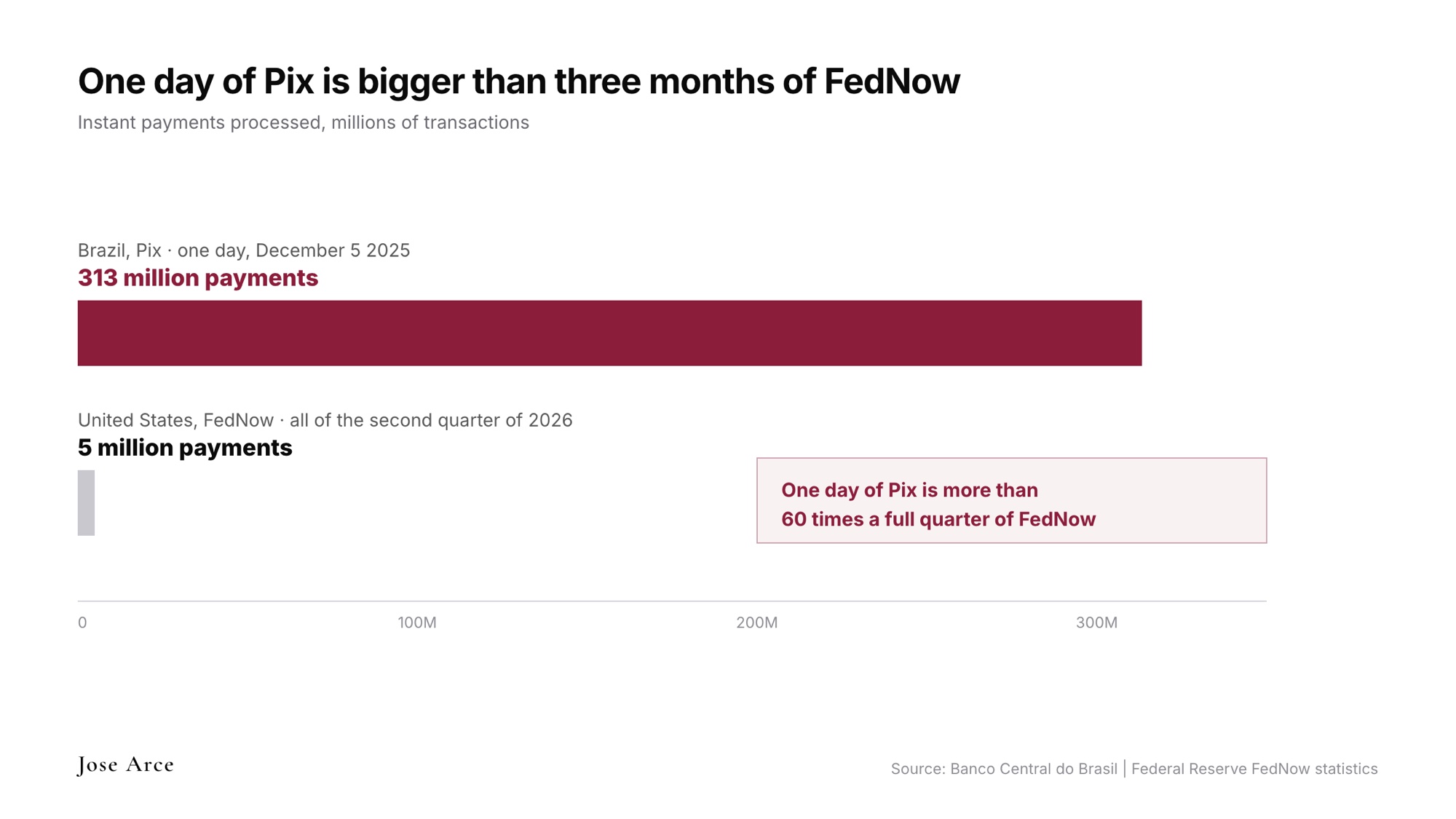
Both are instant payment systems run by central banks. Both move money in seconds, at any hour. What separates them is agreement. Brazil's central bank built Pix as one standard that every bank and payment app uses, so a Pix QR works the same no matter where your account is. FedNow is optional, and after three years about 1,800 institutions have joined.
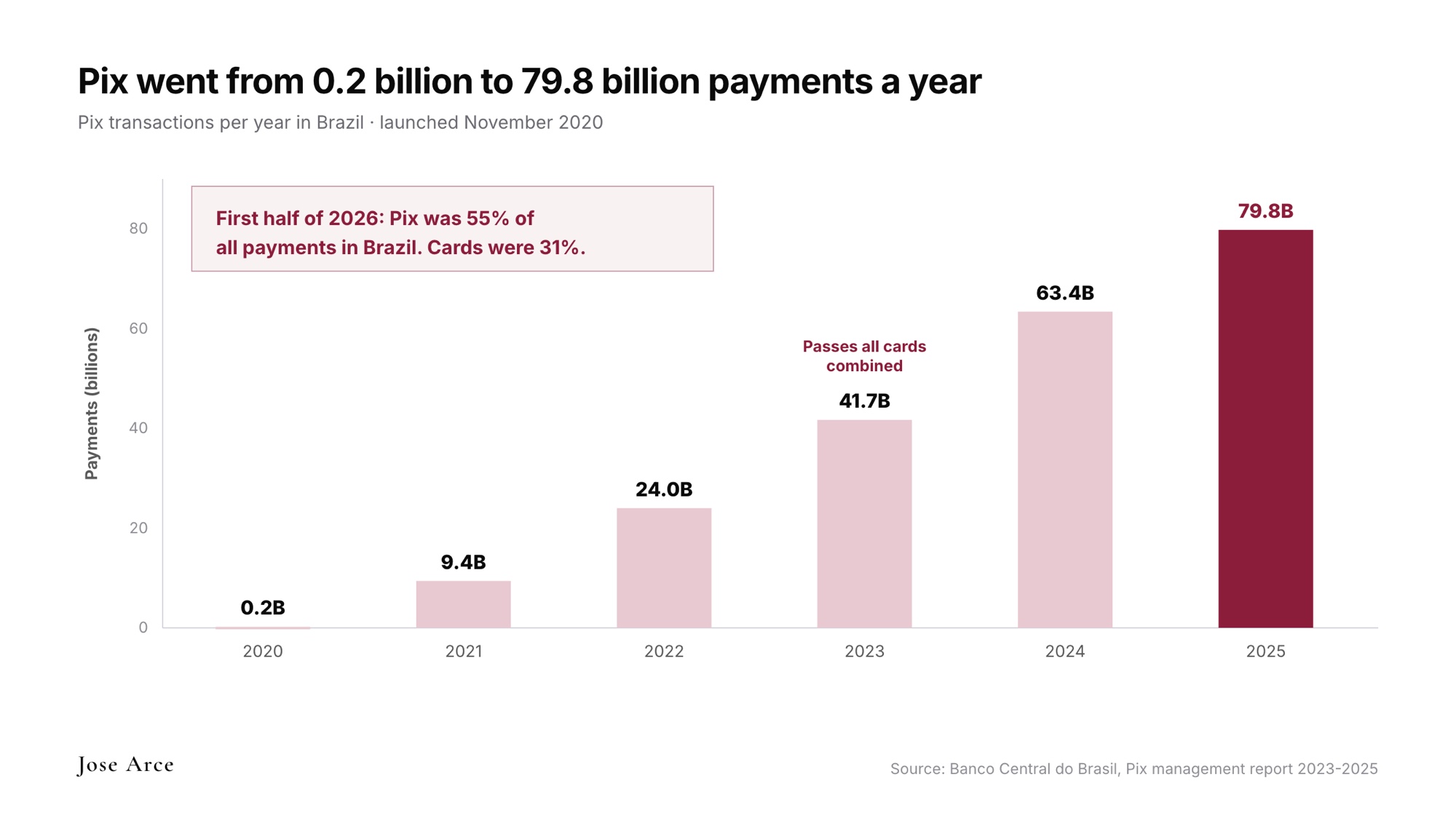
Agreement compounds. Pix went from 0.2 billion payments in 2020 to 79.8 billion in 2025. It passed debit and credit cards individually within about a year, and all cards combined by 2023. In the first half of 2026, Pix was 55% of all payments made in Brazil. Cards were 31%.
India tells the same story at a bigger scale. UPI processed 228 billion payments in 2025, and 24 billion in September 2026 alone, about 800 million a day. It carries 85% of India's digital payments by volume.
Peru shows what happens when separate networks are made to connect. Its two largest payment apps, Yape from BCP and Plin, shared by BBVA, Interbank, Scotiabank and others, couldn't pay each other. In 2022 only about 15% of digital payments crossed from one institution to another. That October the central bank made connecting mandatory, with fines for missing the deadlines. It didn't merge the apps. Each kept its brand, but each had to accept the other. Yape and Plin connected in the spring of 2023, and every bank app and QR code followed that September.
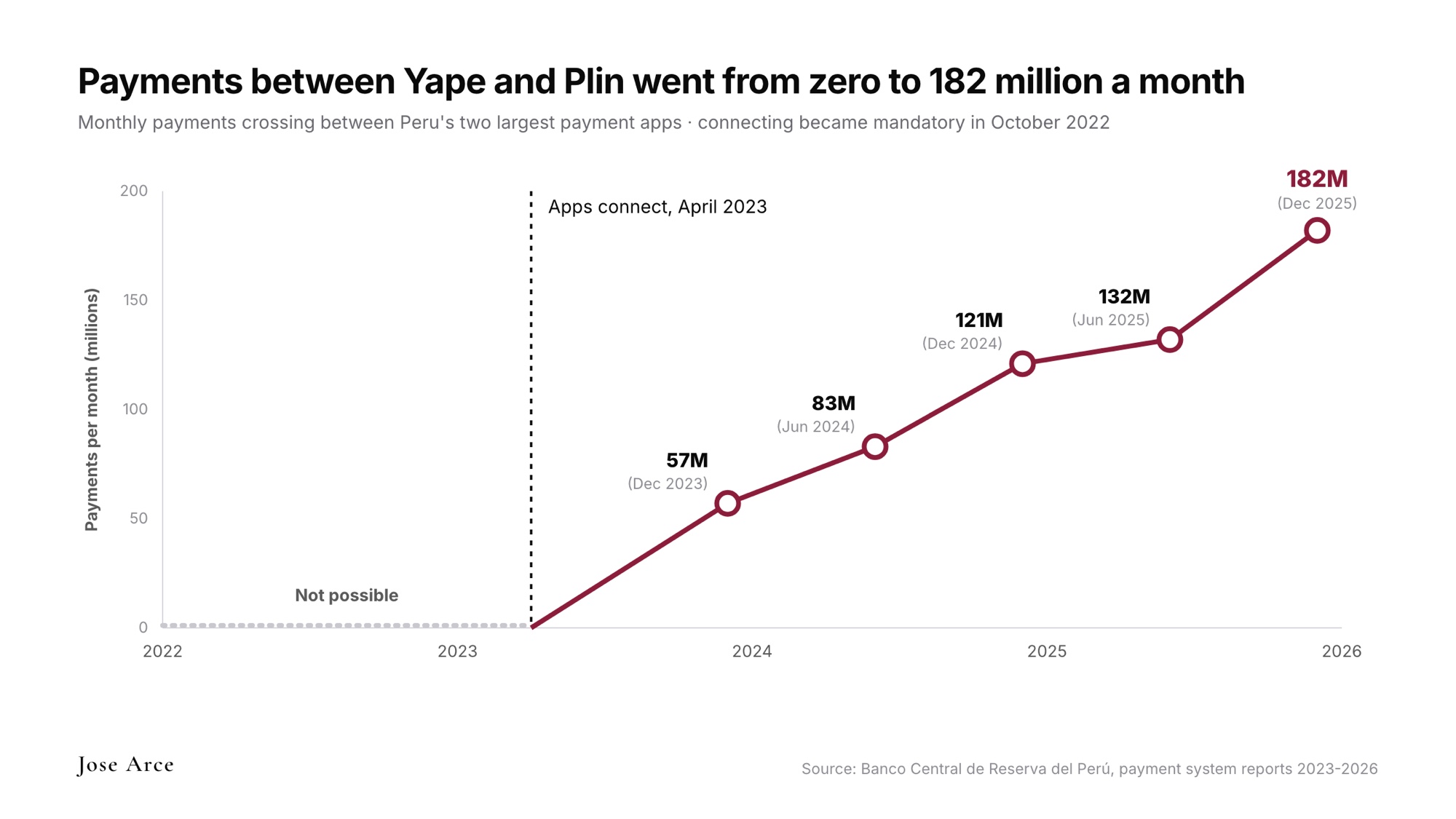
By December 2025, 182 million payments a month were crossing between Yape and Plin alone, a flow that was impossible three years earlier. Peruvians now make 665 digital payments per adult a year, up from 90 in 2021.
I learned this in a smaller market. In 2018 I started Monepagos in Bolivia because a small business there had one digital way to get paid: a card terminal. Settlement took days and the fees came out of an already thin margin. In May 2019 Bolivia's banks launched one QR code that works across all of them. In 2020 the country made 0.45 million QR payments. In 2025 it made 892 million. Instant payments help both sides, but the business gains the most: the money arrives before the customer leaves the counter.
Later, working on OKX Pay, I saw the same question from the crypto side. The dollar is already digital. Why can't it move like Pix?
Look at how the onchain dollar is organized. There are 335 dollar stablecoins tracked today, spread across 170 blockchains. USDC alone is issued on 38 chains and USDT on 13. Exchanges and wallets each push their own network, and some push their own coin.
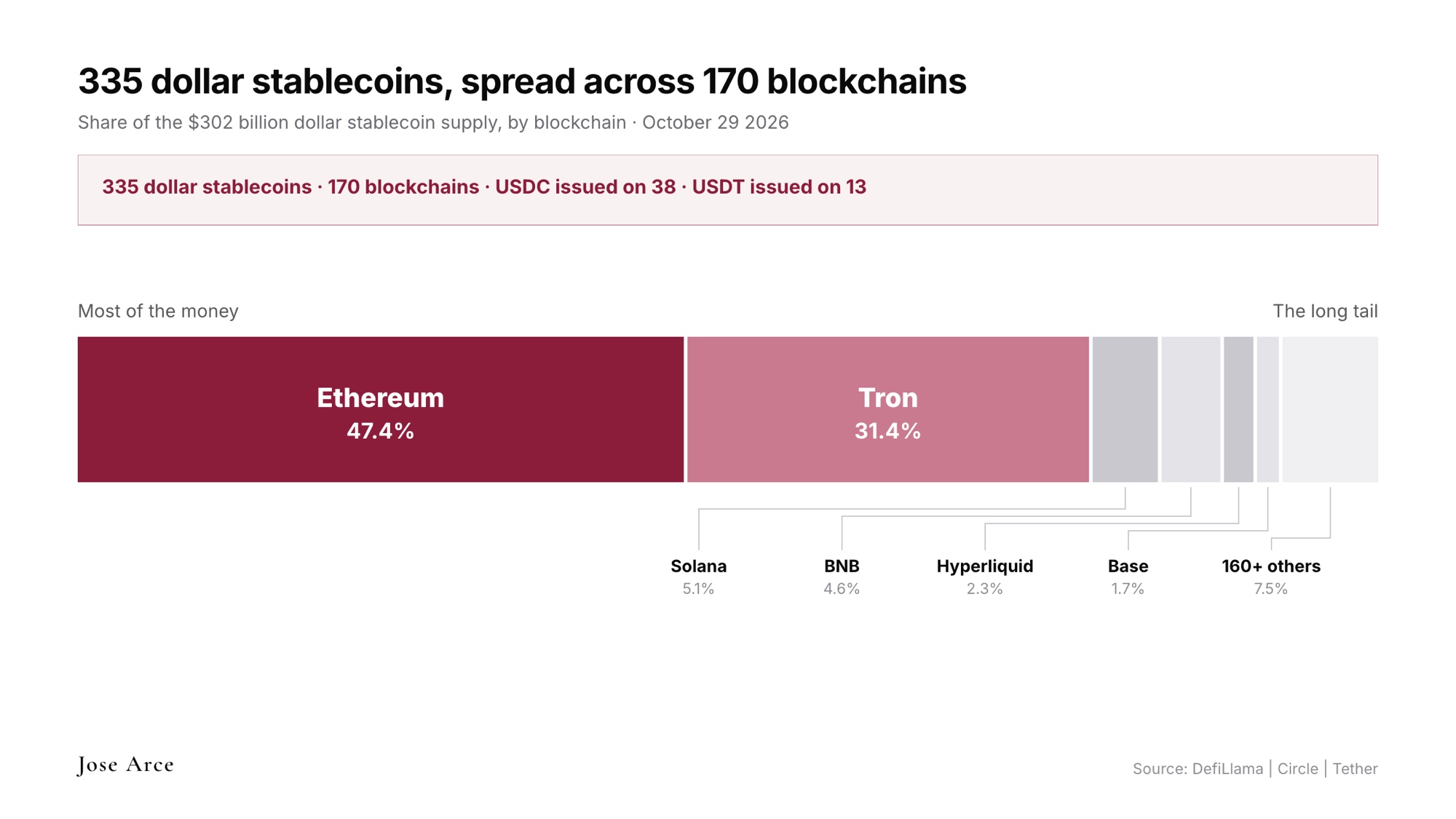
For a merchant, that is the opposite of a shared QR. A customer holding dollars on one chain can't simply pay a shop that receives on another. Moving USDC between chains on Circle's standard route takes 15 to 19 minutes, or seconds if you pay for the fast lane. Bridges, the shortcut between chains, have lost $3.69 billion across 101 hacks. Every hop has its own gas fee.
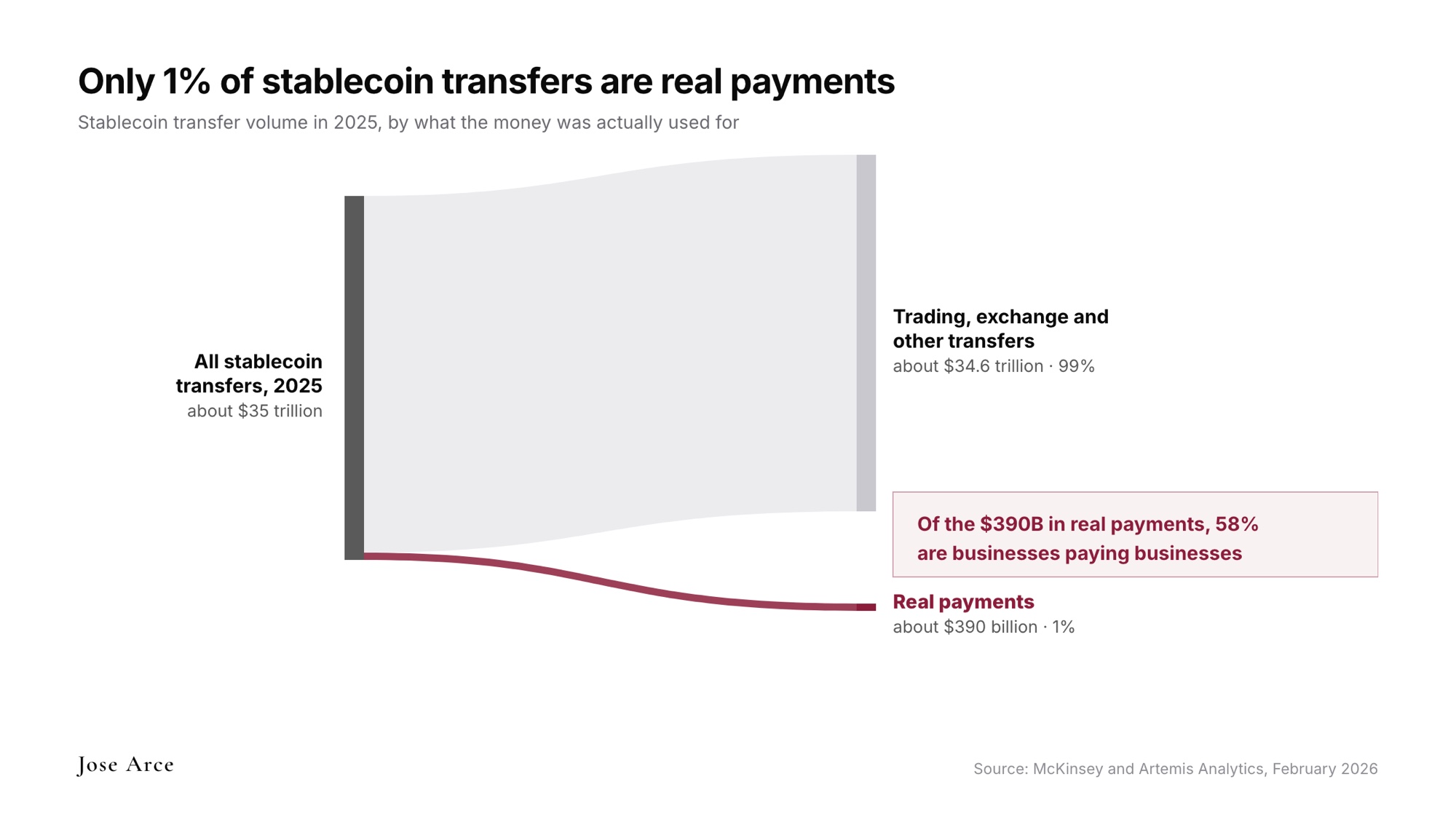
The result shows up in the data. Of roughly $35 trillion in stablecoin transfers in 2025, only about $390 billion were real payments, about 1%. In the most detailed breakdown available, from Artemis, a customer paying a shop directly onchain doesn't even have its own category.
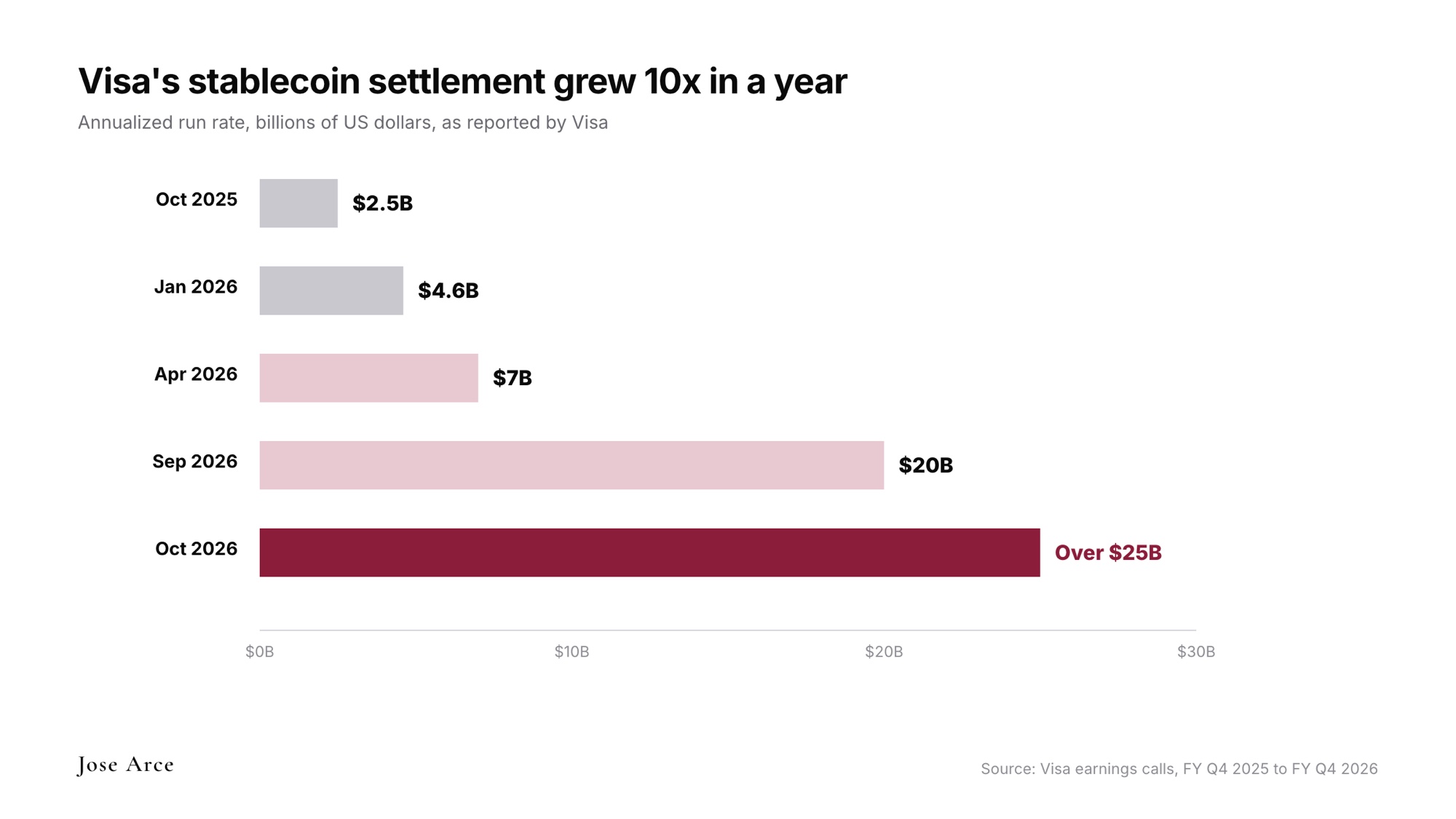
Someone did solve the shared-language problem: the card networks. A card is the one thing every checkout already accepts, so a stablecoin card converts at the point of sale and the merchant never sees the chain. Visa's stablecoin settlement grew from about $2.5 billion a year in October 2025 to more than $25 billion in October 2026.
It's a smart business, and it works. It also puts the most efficient money ever built back on a rail that charges merchants 2% or more and pays them a day or two later. A Brazilian merchant pays about 0.22% on Pix.
Crypto can still have its Pix moment. Stablecoins are already the most widely held digital dollar, they move at any hour, and they settle in seconds on a single chain. What's missing is the decision Peru's central bank forced in 2022, Bolivia's banks made in 2019 and Brazil made in 2020: connect, so any wallet can pay any merchant with one code. Until exchanges and wallets stop racing to own the network, the card networks will keep winning crypto payments.
I've put the full dataset and sources together. Happy to share it with anyone working on payments.